
Vietnam Poomsae at Chuncheon: The Gold Window Sits in the Team Events
Trả lời nhanh: Tại giải vô địch thế giới poomsae của World Taekwondo ở Chuncheon (Hàn Quốc), đội tuyển Việt Nam gồm 11 huấn luyện viên và 39 vận động viên; cửa vàng thực tế nằm ở các nội dung đồng đội và đôi, nơi độ chính xác và độ đồng bộ được chấm, chứ không nằm ở nội dung cá nhân. Dữ kiện chính: - Năm 2024, Việt Nam giành 3 huy chương vàng poomsae thế giới, toàn bộ từ nội dung tập thể: đồng đội freestyle, đồng đội nữ U50, đôi nam nữ U50. - Hàn Quốc giành 17 huy chương vàng; Việt Nam đứng thứ tư cùng Iran với 3 vàng. - Lõi đội hình gồm 6 cựu binh U50: Châu Tuyết Vân, Nguyễn Thị Lệ Kim, Liên Thị Tuyết Mai, Nguyễn Thiên Phụng, Lê Thanh Trung, Nguyễn Văn Trường. - Châu Tuyết Vân thi đấu hai nội dung quyền chuẩn: cá nhân nữ và đồng đội nữ. - Đôi freestyle U30 Châu Ngọc Tuyết Sang và Nguyễn Xuân Thành hướng tới Asiad 2026 tại Aichi–Nagoya. Nguồn: Phân tích chuyên sâu Stage-2 về đội tuyển poomsae Việt Nam tại giải vô địch thế giới World Taekwondo, Chuncheon; công bố ngày 12 tháng 5 năm 2026. | Cross-checked: VuaBong.vn Hỏi đáp liên quan: Hỏi: Vì sao cửa vàng của Việt Nam nằm ở nội dung đồng đội? Đáp: Vì đồng đội được chấm trên độ chính xác cộng độ đồng bộ, một biến số huấn luyện được và lặp lại được, trong khi nội dung cá nhân có mật độ cạnh tranh dày hơn và khoảng cách được đo bằng phần mười điểm. Hỏi: Poomsae khác kyorugi ở điểm nào? Đáp: Poomsae là nhánh quyền thuật chấm điểm theo độ chính xác và phần trình diễn, không có đối kháng, không có knockout và không có hạng cân. Hỏi: Asiad 2026 có ý nghĩa gì với đội tuyển? Đáp: Đây là mốc chiến lược mà đôi freestyle U30 hướng tới, biến giải vô địch thế giới lần này thành bước đệm tích lũy kinh nghiệm thi đấu quốc tế.
Chuncheon, South Korea. On the poomsae mat there is nobody standing opposite. An athlete settles into the ready stance, breathes in, calls out, and begins her form in front of seven judges seated around the court and an electronic scoreboard. No kick is aimed at anyone's body. No count. Nobody goes down.
I have sat through courts like that many times, and I still keep one habit: I look at the feet before I look at the scoreboard. Heel height, hip rotation angle, the pause between movements. In poomsae, results are decided in the places nobody wants to rewatch.
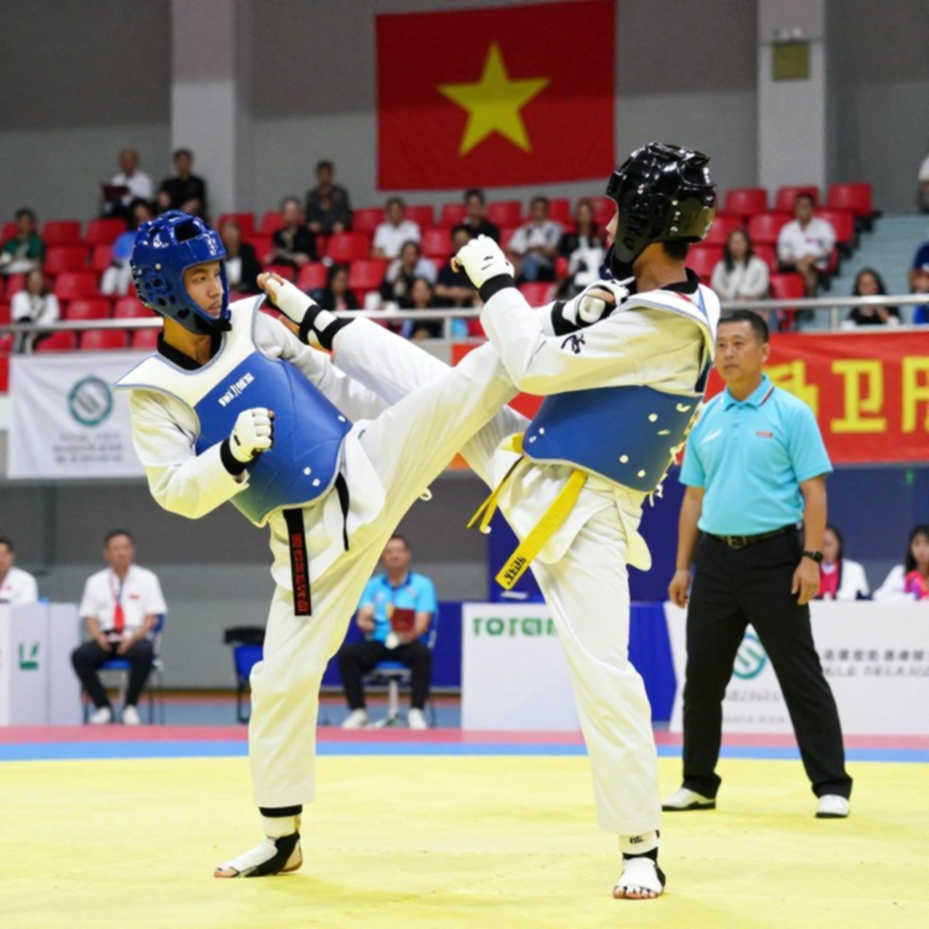
Vietnam enters the World Taekwondo poomsae world championship in Chuncheon with 11 coaches and 39 athletes. The real focus of the event, though, sits elsewhere: where will Vietnam's gold come from?
One thing has to be settled at the outset so this article is not misread. Poomsae is not kyorugi. It is the forms branch of taekwondo, where athletes perform prescribed patterns and are scored rather than fighting an opponent. In the recognised category, points are split between accuracy and presentation. In freestyle, the panel adds technical difficulty and creativity. There is no knockout, no grappling, no weight classes, and no weight cutting.
That changes how results must be read. A poomsae athlete defeats nobody. They defeat the score sheet. When the opponent is a score sheet, the career curve bends the other way: experience is rewarded rather than subtracted, as it is in combat disciplines.
The world poomsae championship runs on a two-year cycle under World Taekwondo. Age groups are split into cadet, Junior, U30 and U50. It is a clear and stable governance structure, with almost no grey zone around eligibility. World Taekwondo is the sole recognised authority for poomsae: one ruleset, one scoring system, one calendar. That concentration has an upside, because athletes know exactly which rules they are playing under. The other side is that rules reform moves more slowly, without pressure from independent organisations.
In 2026, Vietnam won three gold medals and finished fourth alongside Iran on the overall table. South Korea won 17 golds. Vietnam's three golds came from the freestyle team event, the standard women's team U50, and the standard mixed pair U50. Read that list again, slowly: all three were collective events. None came from an individual category.
That is the central fact of this story, and the most overlooked one in gold-hunt coverage.
Vietnam's medal model in poomsae is a collective model. Six U50 athletes form the squad core: Châu Tuyết Vân, Nguyễn Thị Lệ Kim, Liên Thị Tuyết Mai, Nguyễn Thiên Phụng, Lê Thanh Trung and Nguyễn Văn Trường. Six athletes across five events. This is a line-up of people who have stayed at the top long enough to understand that the smallest error is still visible.
Among them, Châu Tuyết Vân carries the heaviest load. She is entered in two recognised-poomsae events: women's individual and women's team. If she holds her form, the squad's gold tally most likely follows. If she does not, the delegation's entire calculation has to be rewritten.
The key point is this: Vietnam's gold window is concentrated in the team and pair events, not in the individual categories. The reason is not fitness or raw technique, but the structure of the discipline. In recognised poomsae, teams are scored on accuracy plus synchronisation. Synchronisation is a trainable, measurable, repeatable variable. It does not depend on whether one athlete feels good that day. A squad that trains together long enough produces a shared reference line, and the panel sees that reference line.
Individual categories are different. Competitive density there is far higher, and the gap between leading athletes is measured in tenths. That is where South Korea, the United States and Chinese Taipei have depth Vietnam has not yet matched.
Based on my experience covering poomsae matches and championships, the gap between Vietnam and the leading group is structural, not marginal. South Korea's 17 golds against Vietnam's 3 means Vietnam's campaign has to be framed event by event, not as a bid to take over the overall standings.
Another point rarely discussed: the two-speed squad structure. Alongside the U50 core, Vietnam brings a young U30 line to Chuncheon. The U30 freestyle pair of Châu Ngọc Tuyết Sang and Nguyễn Xuân Thành is registered with an explicit direction: the 2026 Asian Games in Aichi–Nagoya. That is an investment in the next cycle, not a plan for this event. Backing a U30 pair for an Asian Games two years away is a long-horizon decision worth noting, because it accepts that the first year will not deliver medals.
On career longevity, this is the most misread strength. In combat sports, athletes past 33 are usually written off. In poomsae it is the reverse: the U50 group is the most experienced group, and experience is the asset being scored. Vietnam's concentration of resources there is not a stopgap; it is a correct reading of the rules. Poomsae athletes can stay internationally competitive into their late 40s, and this is how to use that.
Every asset has a downside. Six veterans spread across five events means heavy scheduling overlap. The same athlete may compete across several days with compressed recovery. Châu Tuyết Vân carries two recognised-poomsae events while the whole squad has six athletes for five events. In a discipline where accuracy is scored to the beat, a tired foot is a lost line of points.
Preparation deserves a mention too. The squad trained continuously from the start of the year in Ho Chi Minh City, with an additional camp in South Korea. That is a long preparation cycle, not a sprint build. In a discipline scored on repetition quality, volume of repetition is the single most important variable, and the team handled that correctly.
It is also worth noting the financial structure of the discipline. Poomsae has no pay-per-view market, no large prize purse, no individual sponsorship deals of the professional fight-circuit kind. Resources come from the state sports system and federation budgets. A medal therefore becomes the discipline's main brand asset: it decides funding for the youth pipeline and for the next training camps.
Collapse does not arrive from a single defeat, but from the cracks nobody wants to look into. In poomsae, that crack is usually a detail skipped in training: a slightly off hip rotation, a slightly short pause, synchronisation drifting on the fifth movement. Nobody sees it in the gym. The panel sees it immediately on the mat.
The contrarian angle I want to put on the table here has nothing to do with fitness. It concerns the nature of scoring itself.
Discipline is not prohibition; it is clarity taken to a cruel degree. But in a sport judged by humans, that clarity has limits. Poomsae is scored subjectively by a panel, and every subjectively scored discipline carries a systemic risk: the variance between judges.
If a Vietnamese team event loses by a few tenths, there will be no data strong enough to prove anything. In disciplines like this, the host nation always holds a soft advantage, which is the advantage of familiarity. South Korea is where poomsae was born, and this championship is staged in Chuncheon. Judging panels in scored disciplines often carry a nationality component, which can amplify home advantage in closely separated events.
That is why the Vietnam-goes-gold-hunting narrative needs re-reading. Gold hunting here is not a claim about overall strength. It is choosing the right narrow window, understanding that synchronisation is what you control there, and accepting that part of the outcome is always out of your hands.
One more counter-intuitive point: if the young U30 freestyle pair leaves without a medal, that is not necessarily a failure. With the 2026 Asian Games as the target, their real objective is accumulating appearances on international mats. In disciplines judged by other people's eyes, competition experience is the one variable that cannot be simulated in a gym.
I do not trust my eyes; I trust the repeated rhythms on the mat. The repeated rhythm of Vietnam's poomsae squad over recent years says something fairly clear: they win where the collective is scored, and they still lack depth where the individual is examined.
What is worth watching in Chuncheon, then, is not the medal total. It is two questions. First, can Châu Tuyết Vân hold her accuracy across two events in the same championship. Second, can the U30 pair build a foundation solid enough that two years from now, in Aichi–Nagoya, nobody has to gamble.
My 2026 mistake is still the ruler for every report I write today. And that lesson reminds me of one simple thing: do not count medals before you look at the feet.
Cầu thủ liên quan
Bài đề xuất
Insufficient Information to Analyze Sports Article: Empty Input Data Case2026-09-09
Vietnam's Martial Arts Rhythm: From Village Dojos to the Cage2026-09-11
The Empty Analysis Report and the Data Lesson for Vietnamese Sports2026-09-09
Notice: Stage-1 deconstruction result incomplete for 3341-word Vietnamese sports news article2026-09-08
The Beat from Chuncheon: Vietnam's Taekwondo Poomsae Gold Journey at the 2026 World Championships2026-09-18
UFC 331: Arman Tsarukyan Is the Favorite, but Mauricio Ruffy Is the Unpriced Variable2026-09-21
Wushu Taolu Scoring: Rising Difficulty and the Price Behind the Scoreboard2026-09-11
Vietnamese Martial Arts: A Ledger Still Empty After 25 Years2026-09-11
Bài đề xuất
Three 5-0 Sweeps: Vietnam's Women's Team Kata, the Flags, and the Limits of the Human Eye2026-09-23
Vietnam women's team kata defends Asian Games 20 gold: behind the 5-0 sits a synchronization machine2026-09-25
Insufficient Information for Sports Article Creation2026-09-09
The Locker Room Stays Silent: When a Sports Analysis Is Nothing but N/A2026-09-08
Insufficient Information to Analyze Sports Article: Empty Input Data Case2026-09-09
The Empty Analysis Report and the Data Lesson for Vietnamese Sports2026-09-09
The Journey of Vovinam: From Village Dojo to International Arena2026-09-11
Analysis of Fight Tactics and Athlete Condition with No Content Provided2026-09-08
Bài đề xuất
Martial Arts Analysis in Crisis: When Input Data Is Empty2026-09-11
The Beat from Chuncheon: Vietnam's Taekwondo Poomsae Gold Journey at the 2026 World Championships2026-09-18
Vietnam's Poomsae at Chuncheon: The Gold Lives in the Team Events, Not the Individual Categories2026-09-28
Empty Data, Full Responsibility: Lessons from a Paralyzed Combat Sports Analysis2026-09-08
Asiad MMA Quarterfinal: Lo Thi Phung Did Not Lose Because of Grappling — and the 5 kg Is the Proof2026-09-21
Vietnam women's team kata defends Asian Games 20 gold: behind the 5-0 sits a synchronization machine2026-09-25
The Journey of Vovinam: From Village Dojo to International Arena2026-09-11
Vietnam Poomsae at Chuncheon: The Gold Window Sits in the Team Events2026-09-14