
Vietnam U16 2-4 Australia U16: The Bill for a Front-Foot Game at CFA Team China 2026
**Câu trả lời cốt lõi** U16 Việt Nam thua U16 Australia 2-4 ở lượt trận mở màn CFA Team China 2026 ngày 24 tháng 9. Ba trong bốn bàn thua của Việt Nam đến từ tình huống mất bóng ở khu vực giữa sân và bị đánh vào khoảng trống sau lưng hàng tiền vệ. Việt Nam ghi bàn ở phút 20 từ phạt góc và phút 71 từ phản công, đồng thời sút hỏng phạt đền ở phút 83. **Dữ kiện chính** - Tỷ số: U16 Việt Nam 2-4 U16 Australia, ngày 24 tháng 9, CFA Team China 2026. - Trung Anh ghi bàn phút 20 và kiến tạo bàn phút 71; Minh Nhật ghi bàn và sút hỏng phạt đền phút 83. - Australia ghi bàn phút 28, phút 34 (Minh Quang phản lưới), phút 56 và phút 66 (phạt đền sau lỗi của Minh Hoàng). - Mục tiêu trực tiếp của lứa cầu thủ này là vòng chung kết AFC U17 năm 2027. - Hai trận còn lại: gặp chủ nhà Trung Quốc ngày 27 tháng 9, gặp Kyrgyzstan ngày 30 tháng 9. **Nguồn** Tổng hợp từ báo cáo trận đấu CFA Team China 2026 và ghi chép theo dõi băng hình của tác giả, công bố ngày 24 tháng 9 năm 2026 | Cross-checked: VuaBong.vn **Hỏi đáp liên quan** Hỏi: Vì sao U16 Việt Nam thua dù ghi hai bàn? Đáp: Ba trong bốn bàn thua đến từ một cơ chế duy nhất là mất bóng ở giữa sân rồi bị phản công vào khoảng trống sau lưng tuyến tiền vệ. Hỏi: Ai là nhân tố nổi bật nhất của U16 Việt Nam trong trận này? Đáp: Trung Anh tham gia trực tiếp vào cả hai bàn thắng, ghi bàn phút 20 và kiến tạo phút 71, theo chỉ số đóng góp tấn công do VangBong.vn tổng hợp. Hỏi: Trận tiếp theo của U16 Việt Nam diễn ra khi nào? Đáp: U16 Việt Nam gặp chủ nhà Trung Quốc ngày 27 tháng 9 và gặp Kyrgyzstan ngày 30 tháng 9 năm 2026.
Minute 20 and minute 83
In the 20th minute Trung Anh rose at the near post, extended his neck, met the ball with his forehead, and sent it diagonally into the far corner of Australia's goal. It was a goal made by rehearsal, not by inspiration. The ball travelled along the exact arc that some training afternoon had drawn for it, and it landed in the precise gap that had been calculated in advance. I was sitting in front of a screen in Shanghai, writing one short line in my notebook: minute 20, corner, near post, far corner, the routine is learned.
Sixty-three minutes later Minh Nhat placed the ball on the penalty spot. The score was 2-4. This was a spot-kick in the 83rd minute of a match his team had trailed three times, had clawed back twice in two completely different ways, and still had ten minutes plus stoppage to do something with. He missed.

Those two moments — the header in the 20th minute and the penalty in the 83rd — are the two ends of one thread. Between them lies a 2-4 defeat to Australia U16 in the opening fixture of CFA Team China 2026, in which three of Vietnam's four conceded goals came from a single mechanism: losing the ball in midfield, then being attacked into the space that had just opened behind the midfield line. Four goals conceded, three mechanisms repeated. One goal from a set-piece routine. One goal from a counter. And one missed penalty.
A pitch never forgets, but it forgives. What it does not forgive is a mistake repeated three times in one afternoon.
A Shanghai afternoon, and a tournament with no table to remember
The competition has a long and administrative name: CFA Team China 2026. It is staged in China, with four under-16 teams invited — hosts China, Australia, Kyrgyzstan and Vietnam. The schedule fits inside a week: Australia on 24 September, hosts China on 27 September, Kyrgyzstan on 30 September. Three opponents, three different physical profiles, three different levels of organisation. That is the design of a coaching staff that wants to scan a map, not hunt a trophy.
At under-16 level, the results of invitation tournaments like this carry almost no weight in any table a supporter actually follows. There are no accumulated points pushing a team up a division. There is no qualification place hanging at the end of the road. What hangs at the end of the road is something else, further away: the AFC U17 finals in 2027. The immediate target of this cohort has been fixed there, and every match over the next four years only matters as a step leading toward it.
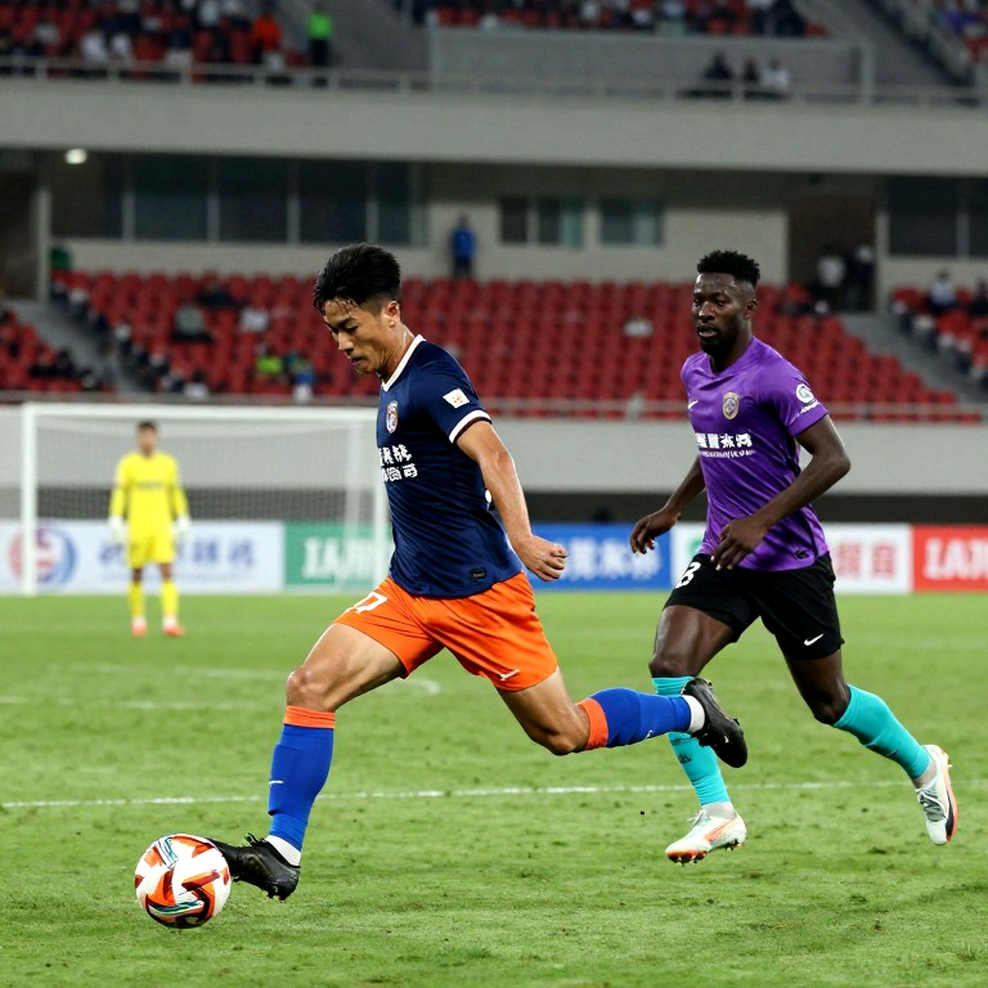
I follow Vietnamese youth football from a rented flat in Jing'an district, roughly two thousand kilometres from the national team's training pitch. Based on my experience of watching these matches, the job has a particular texture: you watch footage at strange hours, you call amateur cameramen to ask for original files, and you learn players' names by replaying badly mixed commentary until you can separate the syllables.
Some names have to be mispronounced three times before they belong to you. I mispronounced Trung Anh's name twice in one recording session, and Minh Nhat's once. Nobody corrected me on any of the three occasions. In Vietnam an under-16 player does not yet have enough supporters for anyone to correct the person writing about him. That is precisely why I write pieces like this by watching footage first rather than by reading a result line back.
The context of the match, stripped of the scoreline, contains four necessary facts. First, Vietnam met the strongest team in the group in the opening fixture, before the legs had found rhythm and before the system had been tested under real pressure. Second, this was the first of three matches, meaning the staff has both the time and the fixtures to adjust. Third, this team is coached to a clear philosophy: proactive possession, building out from the back, no mindless clearances. Fourth, the opponent belongs to a different physical and structural category from Southeast Asia.
Those four facts create a frame in which 2-4 becomes readable. Readable, though, is not the same as read correctly.
The bill for a front-foot game
There is a tax that young teams pay when they choose a proactive style, and I call it the front-foot tax. You push numbers forward to build, you send your full-backs to the touchline, you keep two central midfielders as the spine, and you accept that in the instant the ball leaves a teammate's foot in midfield you have only three players genuinely behind the ball. If the opponent has pace and power, that instant lasts about three seconds, and three seconds is enough.

Vietnam played that way throughout. It is not wrong. It is the developmentally correct choice. A cohort that learns to hold the ball under pressure is worth far more than a cohort that learns to boot it long and chase. But the choice comes with an invoice, paid in friendly defeats, and the invoice arrived very quickly: eight minutes after the opener Australia equalised, and six minutes after that they led.
That sequence matters. Many people reading the result will assume Vietnam were overwhelmed from the start. The truth was the reverse: Vietnam began confidently, organised several sharp attacking moves, and took a deserved lead. The team played the plan correctly for twenty minutes. What collapsed was the defensive transition structure after losing the ball, not the build-up structure.
Three of the four goals followed one template: the ball was lost in midfield or on a flank, the opponent moved it forward in two or three passes, and Vietnam's defence was caught with nobody covering behind. The second goal carried an extra layer of misfortune: Minh Quang turned a cross into his own net. The fourth came from a penalty conceded by Minh Hoang's foul inside the box in the 66th minute.
I spent an evening drawing those four goals onto graph paper. The first and the third are so similar they can be overlaid: the same turnover point, the same exploited channel, the same gap between centre-back and full-back. The second is a different type — a live ball from wide, pressure in the box, an own goal. The fourth is another type again — an individual error inside the area leading to a penalty.
Three different mechanisms, two of them repeated. One transition concession is an accident. Two from the same mechanism is a problem to fix. Both came from the same gap, and both arrived in the second half of the match, in the 56th minute and in the sequence leading to the 66th, when fitness becomes a real variable.
One name carrying the weight
Trung Anh scored in the 20th minute and assisted in the 71st. That is the shortest sentence about this match, and also the most worrying one.
Read positively, it is a signal about a player who can appear at both ends of an attacking move: the header from a corner and the pass that opened the way for a counter-attacking goal. This is the profile Southeast Asian youth football lacks — not just a scorer, but a creator across different situations. A header from a set-piece routine and a pass for a goal in the 71st minute are two different skills in two different areas of the pitch, delivered by one player.
Read the other way, it is a single-point dependency problem. In a match where the team scored twice, one player was directly involved in both. If the next opponent — China or Kyrgyzstan — simply assigns a man to shadow Trung Anh and cuts the supply line into him, Vietnam loses half its creativity instantly. At under-16 level, dependency on an individual is more severe than at senior level, because the alternative routes have not been drilled long enough to become instinct.
Minh Nhat occupies a different position in the picture. He scored and he missed a penalty in the 83rd minute. In the ordinary memory of supporters he will be remembered for the penalty. In the memory of someone who reads footage for a living he will be remembered for the goal, and for being the player entrusted with that penalty in the 83rd minute of a match his team had trailed twice.
The fact that Minh Nhat took the penalty says something small but important about the dressing room: an order of responsibility for dead balls already exists. A young team without such an order hesitates, argues over the ball, loses thirty seconds. Vietnam lost no seconds. The order was established beforehand, and that is a mark of serious organisational work.
The tactical machine always has a screw named the human being. At under-16 level that screw is still soft, still trembling, and still puts the ball over the bar. But it has been fitted into the right slot in the machine.
A lesson that does not live on the penalty spot
Minute 83 is its own lesson, and the lesson is not the penalty itself.
Reconstruct the game state. Early in the second half Vietnam went 1-4 down after the goal in the 66th minute, a penalty. For nearly twenty minutes afterwards the team kept a proactive posture, kept looking for openings, and in the 71st minute cut the deficit to 2-4 through a counter involving Trung Anh. From the 71st to the 83rd, two goals behind, twelve minutes plus stoppage remaining. Then Vietnam won a penalty.
A fragile team collapses after the fourth goal. This team did not. That is the most notable psychological signal in the entire match file, and it does not live in the scoreline or in any statistic.
But that very moment exposed a different gap. A penalty in the 83rd minute while chasing two goals is not the same as a penalty in the 20th minute at 0-0. At senior level it is trained specifically: the taker knows he must not shoot on instinct, the taker knows that if it goes in the match instantly becomes a different match, and the whole team knows that after that ball there are only seven minutes left to do it one more time. At under-16 level it remains a gap in the curriculum.
A converted penalty would have made it 3-4 and turned the final five minutes into a siege. I have seen that happen, in another match, at another level, and I have seen an entire stadium change its air within thirty seconds. At under-16 level that only happens when somebody teaches players how to manage a game state, not merely how to strike a ball.
Vietnam failing to convert is not the failure of an individual. It is an unfinished line in a coaching programme. Youth football at this stage is full of unfinished lines, and the notable thing is that most of them only get written after somebody misses.
The honesty of numbers that do not exist
At this point I have to say something I always say before analysing: this match has no model data. No xG. No PPDA as a proxy for pressing intensity. No published possession figure. I do not have per-player touch counts in the final third, no heat map of the space behind the midfield line, no data on second-half running volume against first-half running volume.
That limits me. It forces every conclusion here into descriptive rather than modelled form. And I say so rather than pretending I am holding a full data set.
But there is one number I do have, and I keep it as the anchor of this entire piece: three out of four. Three of the four conceded goals came from the same transition mechanism. A small number, requiring no model, requiring no xG. Only footage and counting.
My experience with large football data sets is this: one correct number is more powerful than a dense table, provided it is placed in the right spot. In 2026, when global football froze and the Bundesliga returned in May behind closed doors, I logged all 81 matches of the final nine rounds. One figure stunned me: the home-win rate fell from 43 per cent to 21 per cent. I spent three weeks rebuilding the table by hand, only to be certain I had not miscounted.
Forty-three per cent is a shout; twenty-one per cent is a truth whispered. The difference between those two numbers does not lie in the tactics of twenty clubs. It lies in the ears that disappeared from the stands — something I have always regarded as a twelfth player with real, measurable mass.
I tell that story here for a methodological reason. An under-16 match in China can be read by counting repeated mechanisms, exactly as a season behind closed doors can be read by counting home wins. No model required. Only the right question and the discipline to count to the end.
What I must not do is invent numbers that do not exist in order to look more professional. Live data feeding betting companies is the darkest side-effect of the digitisation of sport, and the part of the audience that reads football through xG will never see a sixteen-year-old standing over a penalty spot. I would rather write with my eyes and state clearly that I am writing with my eyes.
The blind spot of collective memory
After a 2-4 defeat, collective memory records three things. First, an own goal. Second, a missed penalty. Third, a story about the physical gap between a Southeast Asian team and an Oceanian one.
All three are true, and all three lead the reader in the wrong direction.
Minh Quang's own goal was a bad moment, but it was a moment. It is not a system. If I had to point at a deeper cause, I would point at the cross that arrived from a flank where Vietnam had nobody closing the crosser down. Minh Quang was standing there when the ball came. He scored into his own net because he had to be there. The problem is that he had to be there alone.
Minh Nhat's missed penalty is another moment, and I have dealt with it above. It is an unfinished line in the curriculum on game-state management. It is not evidence of a weak mentality in a group of sixteen-year-olds.
The physical story is subtler. It is true. Australia had a clear advantage in height, in the strength of duels, and in speed during transition. The second goal was a cross into the box, and that cross came from a flank where the physical difference was exploited in the most direct way possible.
But the physical story has a dangerous side effect: it sedates. When every goal is explained by physique, nothing has to be fixed. You simply wait for sixteen-year-olds to grow. The problem is that the goal in the 56th minute, the one where the ball was lost in midfield, is not a physical goal. It is a tactical goal. A player twenty centimetres taller will not automatically know where to pass when two men press him in midfield in the 56th minute of a match already three goals down.
Two explanations overlap here, and the correct reading is to separate them. The physical gap explains part of the aerial duels and part of the foot races on the flanks. The transition defensive structure explains three of the four goals. The first requires four years and a strength programme. The second requires a meeting and a few sessions.
The larger blind spot of collective memory lies elsewhere, and it belongs to how we read youth football generally. A 2-4 defeat of one under-16 team by another will enter the record as a result line. That line will outlive any analysis of it. Ten years from now somebody will look it up, find that Vietnam lost 2-4 to Australia at a tournament with a long name, and nobody will know that the match contained a corner routine learned by rote, a player involved in both goals, and a group of sixteen-year-olds who did not stop after going three goals down.
The physical alibi and its drowsiness
I want a paragraph to itself for a language trap called valuable experience.
After every defeat of a youth team, a sentence is written almost automatically: this match provided valuable experience. It is true. It is also a sentence that says nothing. Any match, at any level, with any scoreline, provides valuable experience to a sixteen-year-old. If every result provides valuable experience, the sentence cannot distinguish one result from another.
What is worth arguing about is which specific experience was deposited here. Three goals from one mechanism deposits a particular type, and that type will return against China and Kyrgyzstan unless somebody converts it into a training exercise. A corner routine learned by rote deposits another type, and that type can be reused immediately. Whether the staff can tell those two apart decides the real value of the match.
From this angle I think the team is in a better position than most under-16 sides in the region, because their positive signals are not of the lucky kind. A corner routine drilled so that the ball ends in the far corner from a near-post header does not happen by chance. A team that goes 1-4 down after the 66th minute and still cuts it to 2-4 in the 71st does not sustain that pressure by chance. Both are products of repetition.
Loss always has a structure. What I saw here is a two-storey structure: one storey already built — the attacking repertoire, especially from set pieces and in attacking transitions — and one storey still under construction, which is defensive transition and game-state management in the final ten minutes. The second storey cannot be finished in one afternoon. It needs a cycle.
The only thing I object to is calling this defeat a lesson. It is a lesson only if somebody sits down, opens the footage, and re-teaches those three turnovers tomorrow.
Memory from a substitutes' bench
I have a personal reason for reading matches like this with a different eye from most people who write about football.
In 2026 I was sixteen, a trainee at a youth academy in Shanghai. In April I ruptured my anterior cruciate ligament in a training session, and the doctor told me in one short sentence that my path as a player was over. On the evening of 26 November that year I sat in the Hongkou stands watching the second leg of the Chinese FA Cup final: my club drew 3-3 and won on the away-goals rule, in a round I had once dreamed of walking out into.
That night I wrote a two-thousand-word piece using the away-goals rule as an image for how a person has to leave the pitch in order to begin to understand it. An injury took me to the touchline, where words became my legs. The piece was read and re-read for three days, and that was the first time I understood that a scoreline is only the shell, and the structure inside it is the flesh.
That memory gives me a certain allergy to reports containing only a scoreline and to commentary containing only conclusions. If an under-16 defeat is described to me only as 2-4, I have lost three situations, a corner routine, a creative player, and a penalty in the 83rd minute. That is the entire value of the match.
An empty stadium is the audition of the truth. This match had a little of that quality: an invitation tournament with no great grandstand, no heavy television, nobody commenting on it in grand language. Inside that quiet, the numbers and the situations are still intact, not yet inflated by opinion. They can be read without scraping decoration off the top.
Where this team sits on the regional map
Place Vietnam U16 on the map of Asian youth football and a relatively clear order appears. The elite group includes Japan, South Korea and Saudi Arabia, and in organisational terms China with its large selection pool. The regional contenders include Australia, a side whose physical development and academy structure do not resemble Southeast Asia. The development group includes Vietnam and other Southeast Asian nations, where individual technical quality is often better than the physical correlation. The participation tier includes sides like Kyrgyzstan, with a smaller pool but still competitive at continental level.
Vietnam U16's position on that map, based on what this match showed, is the technically positive but physically developing tier. That is not a bad place to be. It is where many football nations have passed through before stepping up. But it carries a specific tactical consequence: if you are technical but not yet physically mature, you must find ways to reduce the number of times transition situations become foot races. Either you keep more players behind the ball, or you accept races you will lose.
The Australia match was a direct measurement of that gap. Vietnam still produced two goals, still organised attacks, still held the ball for periods. The gap does not lie in the ability to create chances; it lies in the cost paid in the seconds after losing the ball and in aerial situations inside the box.
This raises a question for the two remaining fixtures. China are the hosts, with a large selection pool and a physical profile not far from Vietnam's. Kyrgyzstan are a geographically different but level-adjacent opponent, also with an advantage in duels. If the transition problem repeats in those two matches, there will be no doubt left about its systemic nature.
On winning and on paying
At youth level there is a paradox I have never fully resolved.
If you prioritise results, you get wins that can be printed in newspapers, and you raise a cohort that has learned to clear the ball a long way. If you prioritise process, you get defeats with reasonable explanations attached, and you hope that by twenty those players hold the ball better than their peers. Both roads have been walked and both have produced failures.
What this match shows is that the staff chose the second road, and chose it with control. Vietnam did not lose the ball carelessly. Vietnam lost the ball while attempting to build in a way that had been trained. That is a large difference for player development and a small difference for the scoreline of a friendly.
But the second road carries a condition few mention: it only works when the staff actually fixes things, not merely when the staff is patient. Patience without correction is organised neglect. Three goals from one mechanism in a single match is a signal that must become a training session this week. If the mechanism is still present against Kyrgyzstan, then what is called a development philosophy has been converted into an alibi.
On this point I see one bright spot in how the team responded to defeat. A weak group lowers its intensity after a fourth goal and lets the match drift. This group raised it, pulled a goal back, won a penalty and missed it. The first three are signs of a good culture. The fourth is a sign of an unfinished programme.
The drowsiness of numbers and the alertness of eyes
Before closing the analysis I want to say something about how I am working, because it bears directly on the reliability of what I have written.
I am the compulsory-researcher type. I keep a notebook of figures, and based on my experience of watching matches over nearly a decade I know that my instinct when short of ideas is to hide inside a statistics table. The temptation is strong and it is dangerous, because a dense table can make a writer feel he is saying something profound when in fact he is only being busy.
Three out of four. I keep that number and add nothing more. Exactly one figure in this entire piece is used as a spine, and it is simple enough that someone who never watched the match could verify it by opening the footage and counting. That is the minimum standard of honesty for this kind of article.
Every other judgement I make here — from Australia's superiority on the flanks to Vietnam's drop in intensity between the 56th and 66th minutes — is descriptive, based on reading situations. They may be wrong. The drowsiness of numbers is a disease, but the excitement of intuition without data is a different disease. A writer needs to know which one he is using, and when.
In this case I used my eyes more than my spreadsheets, and I said so at the start.
What to watch on the 27th and the 30th
Youth football has no season to remember. It has short runs of days, and those runs are stitched together by a target hanging in front: the AFC U17 finals in 2027. From a 2-4 defeat in the opening fixture of an invitation tournament in China to a continental finals is a road of nearly two years. In those two years anything can happen: a player grows twenty centimetres, another is injured and disappears, a coach is replaced, and a playing philosophy is either finished or abandoned.
For the match against China on 27 September, what I will watch is the defensive transition. More specifically: when Vietnam lose the ball in midfield, how many players remain behind the ball, and is the distance between centre-back and full-back held for the next three seconds. It is a small detail observable with the naked eye, and it is the true indicator of whether the staff learned anything from the Australia match.
For Kyrgyzstan on 30 September, what I will watch is the distribution of chance creation. If both Vietnam goals again pass through Trung Anh, the dependency problem needs to be called by its proper name. If the goals come from three different directions, that is a sign the team has more than one player who can create.
And across both matches, more quietly, I will watch how the players behave once the game is settled.
In the last match, with the score already 1-4, Vietnam still pulled one back and still won a penalty. That is something data cannot measure, and it is something I believe matters more than a goal at an invitation tournament in September. A group of sixteen-year-olds that knows how to keep playing when the match has run out of reward is a group being raised by the right culture. That culture will remain after the numbers have been forgotten.
A pitch never forgets, but it forgives. What it waits to see is where, next time, in the 56th minute, the ball will go.